It’s not what you say, it’s how you say it: #ShibbolethProblems

Ever wonder what the Bible, Inglorious Basterds, internet authentication codes, and accent modification have in common? Read on, padawan.

English not your first language? Click on hyperlinks for definitions of idioms and vocabulary!

Screen Shot 2015-01-18 at 7.53.02 PM


Once upon a time, two tribes in the Bible were fighting. This particular disagreement involved two neighboring tribes: Gileadites versus Ephraimites. The Gileadites had the upper hand; they controlled an important part of the Jordan river. As it happens, some of the Ephraimites really wanted to cross the Jordan river (perhaps the the grass was greener on the other side?).

https://i0.wp.com/cgge.aag.org/WaterResources1e/cs-1/paste_image10.jpg

The Jordan River

As one might imagine, the Gileadites did not want the Ephraimites to cross the river. The Gileadites controlled the crossing, but were faced with quite the quandary. In those days, it was hard to tell who was who. Both the Gileadites and the Ephraimites spoke the same language and presumably shared a similar wardrobe of Jesus sandals and chic homespun sack dresses. What’s a warring Semetic tribe to do? The clever Gileadites devised a state-of-the-art defense system to prevent their enemy from crossing into their hard-won territory: a one-word language test. Those who wanted to cross the mighty Jordan river had only to say the word “Shibboleth” to  traverse the river. Simple enough, huh? Maybe not. See, the Gileadites pronounced the word “Shibboleth” /ʃɪbəlɛθ/ (with an “sh” sound at the beginning), but the Ephraimites said “Sibboleth” /ˈʃɪbələθ/ (with an “s” sound at the beginning). According to the King James Bible, this simple language test resulted in the death of “forty and two thousand” (42,000?) Ephraimites.

SAY WHAT (see what I did there?). Yep, accents, dialects, and differences in language and speech serve as identity markers. The language(s) you speak and the way(s) you speak give listeners information about who you are. In this case, the difference in pronouncing one sound, was the difference between Gileadite and Ephraimite and life and death. Rough deal. 

For a more contemporary take on Shibboleths, check out the Inglorious Basterds vid below:

Basically, all hell breaks lose when this handsome Nazi-killer-posing-as-a-Nazi (left side) orders some whiskey at 0:47 using the wrong hand gesture, and therefore exposing his non-German identity. 


The hand gesture for “3” in German = SHIBBOLETH. Dope, huh?

Shibboleths occur all around us and on many levels. There’s an internet authentication system called Shibboleth, there are shibboleths for dialects of German, Spanish and French. There are Shibboleths within dialects and accents of languages (look here for a brief explanation of the difference between accents and dialects). Click here for a working list of shibboleths. Share one in the comments!

So, what’s the drama, mama?

In short, Shibboleths are the culmination of the linguistic, cultural, and personal identities that are encoded in language. As a result, accents and dialects carry a great deal of emotional baggage. They say whether you’re part of the group, or not.

As it turns out, my hometown was voted to have the ugliest accent in the whole world. Like, BBC said it was the worst accent in the world. Watch on:

Now, in my undergraduate Applied Linguistics courses, we learned that there is nothing inherently superior about one language, accent, or dialect. That is, there is no “right” way to speak any language in terms of grammar or pronunciation. Dialects of English like African-American Vernacular English (AAVE) and Southern dialects have their own, systematic sets of grammar and pronunciation rules that are used consistently by speakers of those dialects. Stay with me…

Language is defined as, “a :  the words, their pronunciation, and the methods of combining them used and understood by a community”

“Language.” Merriam-Webster.com. Merriam-Webster, n.d. Web. 18 Jan. 2015.

They key part here is: “understood by a community.” Language is an abstract set of symbols to which groups of humans assign meaning.

The rules of language are determined by how people use that language. Perceptions of an accent are determined by who the people using that language, dialect, or accent are.

This is my dog, Kelbi. If I were French he would be my chien. Israeli, כלב (kelev).

Each word combines different sounds and different letters, yet they all refer to the same thing:

10930156_10203256771448096_6905078292864005431_n

this guy

It’s just that my fellow Americans have an unspoken agreement that the letters D-O-G represents a furry four-legged canine. People identifying as French-speakers have an implicit group-knowledge that this guy is a C-H-I-E-N.

See where I’m going with this?

We assigned a concept some letters, and it works because we all agree to use this combination of letters to represent this idea.

But besides the image of my furry guy with four legs, the abstract combination of symbols (words) dog and chien actually have other meanings that we, as groups, assign to them. If I hear a person in the airport talking about their chien, I might make the presumption that this person is French. Depending upon his accent, I might be able to detect French (France) vs. French (Cameroon). Perhaps then, my brain might imagine that this person enjoys wearing berets and eating baguettes.

By the same token, if I hear a person say, “That ain’t right,” instead of “That isn’t right,” my brain might jump to several conclusions about that person’s race, socioeconomic background, level of education, etc.

This is where things turn ugly.

In an oft-cited series of studies, Dr. John Baugh found that people are sensitive to different accent and dialect markers.

“Baugh’s ongoing study shows that over the phone many Americans are able to accurately guess the age, race, sex, ethnicity, region of heritage and other social demographics based on a few sentences, even just a hello.”

Rice, P. (2006, February 2). Linguistic profiling: The sound of your voice may determine if you get that apartment or not. Washington University in St. Louis: Newsroom. 

His studies involved calling to inquire about apartment advertisements using a Spanish-English dialect, African American dialect, and what some call, “Standard English” (though technically, no such thing exists. See: idiolects). He found that people on the other end of the line were easily able to identify different dialects. He also found that those speaking with an African American or Spanish-English dialect were less likely to get return phone calls and were more likely to be told that the apartment vacancy had already been filled. If you’re thinking, “That’s racist!” Then, you’re right.

This idea that we judge people based on their accent (coined, “Linguistic Profiling”) has picked up momentum in recent years.

So, while certain accents may sound great on movie stars, and charming men on vacation, for the average José, foreign-accented speech can make life in the US a little difficult. Here are some things I found whilst poking around some academic articles:

*Keep in mind that these results pertain only to specific accents and dialects in specific situations, under specific conditions.

Listeners can have negatives biases towards nonnative accents even if they have no problem understanding them. (Hosoda & Stone-Romero, 2010)

According to marketing research, “individuals were more likely to choose a company or a product when a message was read with an American-English accent than in Mandarin or French accents.” (Carver, 2014)

“Research shows that applicants with an accent of a dominant group in society are judged to be suited for high status jobs, whereas applicants with foreign accents are viewed as appropriate for low status jobs (e.g. de la Zerda and Hopper, 1979; Giles et al., 1981; Kalin et al., 1980; Kalin, 1982; Ryan et al., 1984)” (Hosoda & Stone-Romero, 2010)

For a comprehensive review of accented language literature and methodologies check out Gluszek & Dovidio, (2010)

So, what does this all mean? It means that having an accent is a Shibboleth. It is a distinct marker that one does not belong to a certain group. Not belonging to the dominant language group can have positive or negative implications for your career, social life, and identity.

In order to mitigate some of the negative outcomes associated with having foreign-accented speech, some people turn to accent coaches and to speech-language pathologists (SLPs) for accent modification services.

According to the American Speech & Hearing Association (ASHA):

“An SLP can provide services to speakers who want to modify or reduce their accent.”

“SLPs work with the full range of human communication and swallowing disorders in individuals of all ages.”

Yet there is a controversy surrounding SLP involvement in accent modification. On one hand, SLPs have a unique knowledge of language and skill set that, to me, seems readily applicable to accent modification. On the other hand, I’ve also heard SLPs say that accent modification is a communication difference, not a disorder and is thus beyond our scope of practice.

Then there the ethical implications of changing (I prefer, modifying) someone’s accent. When a classmate asked me if I thought accent modification was ethical, it gave me pause. Accent and identity are inherently intertwined. Is it ok to change someone’s accent? Does changing your accent change your identity? Is accent modification ethical?

Here is my take: Accent modification is a service provided to those who seek it for personal or professional reasons. If someone is not being understood or their accent is interfering with their daily life (i.e. avoiding social situations or phone calls, experiencing negative service encounters, negatively impacting career growth), that is a functional language problem, which an SLP is trained to alleviate.

I pose this question to you: if you were an Ephraimite or a badass Nazi-killer with access to a stellar accent modification service, would you use it?

Bibliography:

http://news.wustl.edu/news/Pages/6500.aspx

http://www.news.cornell.edu/stories/2014/10/accents-impact-workplace-and-consumer-choices

Click to access frthcoming%20ijrm%20d-12-00014_wang%20et%20al%20.pdf

http://psr.sagepub.com.ezproxy.library.wisc.edu/content/14/2/214.full.pdf+html

Click to access newsrelease.20100719.accents.pdf

http://onlinelibrary.wiley.com.ezproxy.library.wisc.edu/store/10.1111/imig.12005/asset/imig12005.pdf;jsessionid=E9ED9AEE074EB9173A7AE180A0FD7C4B.f01t03?v=1&t=i53b4hy4&s=066422622a70e97e7b6908ba3cf67bb28a7a152d

Megumi Hosoda, Eugene Stone‐Romero, (2010) “The effects of foreign accents on employment‐related decisions”, Journal of Managerial Psychology, Vol. 25 Iss: 2, pp.113 – 132

← Back

Thank you for your response. ✨

Beach, not b*tch: American English Vowels

Pronunciation is one of the most difficult things to learn and teach in a foreign language. Looking for pointers and resources? Look no further.

This post introduces some pronunciation and Phonetics basics and susses out the difference between “beach” and “bitch” (Israeli friends, I’m looking at you!).

For more on that conundrum:

What’s an Italian in Malta or an Israeli in America to do?

Languages have different inventories of sounds. If you don’t have a sound in your first language, it’s more difficult to acquire it in your second…

…but not impossible!

First, you need to know that the alphabet in English is poorly suited for teaching pronunciation. Instead, you can use IPA. While learning IPA can be a big time commitment, it really is the best way for you to understand pronunciation and teach it.

I was surprised to find that a lot of my students in Korea were familiar with IPA prior to coming to my academy, so if you do know it (and you’re a teacher), use it in the classroom! Even if you don’t teach it explicitly, it can be a helpful visual aid.

Now, let’s talk about butter.

Screen Shot 2015-01-16 at 1.07.33 AM

Some people in the UK call this [ˈbʌ.tə]. They make the /t/ sound sound nice and crisp.

Most people in the US call this [ˈbʌɾɚ]. This sounds more like “budder.” Smooth. Like buddah.

Click here to hear the two different pronunciations.

Take-home: Sounds ≠ Letters. This is important for understanding your (students’) pronunciation errors and pointing out alternate pronunciations depending on the context(s) in which you(r students) will use English. It also the difference between sounding like a suave cowboy or a British villain.

So suave. Like buddah.

≠

Evil.

Learn IPA.

Here is a quick reference guide for IPA basics & linguistic terms:

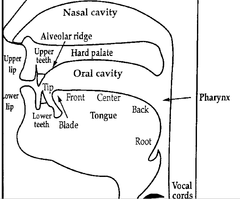
Here are some of the anatomy basics you can use as a reference:

You are looking at a profile view with the nose and mouth on the left and the back of the head/neck on the right.

Vowels:

Vowels are created when air flows unobstructed through the oral cavity. The different vowels we hear are created when we raise and lower our tongue, push it forward or backward and round our lips.

Screen Shot 2015-01-16 at 1.55.43 AM

In English, vowels are represented by the letters A, E, I, O, U (and sometimes Y).

This chart shows 12 different vowels commonly used by North American English speakers:

American English Vowel Quadrilateral

If this looks like Greek to you, don’t panic! Let’s break it down. Imagine you’re looking at a head in profile:

Mid-sagittal (profile) view

The vowel quadrilateral is a chart that can be superimposed on the human oral cavity to show the different tongue positions that result in different vowels.

The vowel quadrilateral gives you four different types of information about vowels:

1. Height

The left-hand side gives you information about tongue height: high, mid, or low

So, /i/ as in “see” is a high vowel, because your tongue moves up, leaving a small column for sound to travel through. /æ/ as in “back” is a low vowel. Your tongue moves down. Try this: say out loud “Eat. At.” [it] vs. [æt]. Put your hand under your chin. You’ll feel it drop down for “at.”

2. Position

The top axis gives you information about how close to your teeth or to the back of your throat the highest point of your tongue is when producing that vowel. Say “tee” and “to” out loud. In “tee” [ti], the highest point on your tongue is close to the front of your mouth. In “to” [tu], the highest point on your tongue is closer to the back of your mouth.

3. Tense/Lax

The shaded interior of the vowel quadrilateral marks lax vowels. Tense/lax is referring to your muscles. Are they tense as in “peep” [pip] or lax as in “pip” [pɪp]?

Screen Shot 2015-01-16 at 2.38.14 AM

(4. Lip Rounding)

Lip Rounding in this chart is denoted by the box. Only back vowels can be rounded. (Back) rounded vowels are:

/u/ as in “tooth” [tuθ]

/ʊ/ as in “book” [bʊk]

/o/ as in “poke” [pok]

/ɔ/ as in “thought” [θɔːt]

Therefore, each vowel can be classified using four parameters.

/i/ is a (1.) high, (2.) front, (3.) tense, (4.) unrounded vowel

/ɪ/ is a (1.) high, (2.), front (3.) lax, (4.) unrounded vowel

Herein lies the problem of our Italian man in Malta. “Beach” [bitʃ] and “b*tch” [bɪtʃ] only differ by one parameter: tense/lax. In “beach”[bitʃ] the vowel is tense, and in “b*tch” [bɪtʃ] the vowel is lax. How could you change this? The first step is awareness of the difference. Listen for it. Repeat the two sounds to yourself. When referring to a female dog, hold the vowel a little longer. This will help signal that it’s the tense version. Does the meaning of the word change? Next step: Practice. Or Accent Modification.

/a/ is a (1.) low, (2.) back, (3.) lax, (4.) unrounded vowel

Practice! Classify each vowel giving the following information: 1. Height 2. Position 3. Tense/Lax 4. Rounded/Unrounded.

Here’s a cheat sheet:

Now write an example word for each vowel. Post them in the comments below for feedback!

Diphthongs:

Diphthongs are two-part vowels. English diphthongs are often written in different ways as they vary by dialect. Here is one representation of English diphthongs:

*even though they use English words as a reference point, keep in mind that these can be pronounced very differently.

Click here to access my favorite website for learning phonetics! It shows animations of productions of different sounds and plays the sound too! It’s a great demonstration tool for your students.

Stay tuned for the next post all about consonants. It’s the difference between rice and lice!

Questions? Thoughts? Comments? Post! Feeling shy? Email me at theaccentologist@gmail.com

← Back

Thank you for your response. ✨

Your First English Teaching Job in Korea

안녕하세요

Anneyonghaseyo! 

Interested in teaching English? Thinking of Korea as your next destination? Read on!

A weekend hike up Munsusan with good friends!

A weekend hike up Munsusan with good friends!

On a sunny Saturday morning in July 2014 I found myself atop this 600m peak with my best friend from kindergarten, my best friend from Korea, my best Korean friend, and a man who was  neither Korean nor friend.

Korea can be like that; everything is at once familiar, yet remarkably outlandish. For instance, there is Pizza Hut on every corner but surprise! your pie is covered shrimp, blueberries and spam. Oh, and the crust is stuffed with sweet potatoes. Don’t worry–all of the flavors are balanced by the mandatory side of pickles…

Pickles from Korean Pizza Hut

If adventurous eats, casually scaling enormous mountains, cultural exploration and an appreciation for fermented cabbage and rice-based alcohol appeal to your inner adventurer, consider Korea as the next place to hang your hat.

I taught English in Korea on a gap year between my undergraduate and graduate programs. It was challenging, crazy, fun, and (of course) an intense learning experience. All travel clichés and hyperbole aside, here are some things to consider should you decide to follow the path of many an English teacher in the Land of the Morning Calm:

Requirements

To teach in Korea, you will need an E-2 visa. Korea4Expats has a lot of detailed information on specific requirements. Most people with a clean criminal record and a bachelor’s degree in any subject can teach English in Korea, however some jobs have a preference for those with degrees in Education, Linguistics, Teaching English as a Second Language etc. My employer required all teachers to have a TESL certificate at minimum which can be procured through online classes. Click here for more on ESL certification options. Visit acronym city if you lost me at “ESL.”

If you are coming from the U.S., leave at least 2-4 months between when you start your background check and when you expect to leave (seriously, bureaucracy is alive, well, and still using snail mail). The visa process can be tedious and expensive (~$300). It takes money to make money.

After starting your background check, it’s time to job hunt! You need a signed contract in order to apply for an E-2 visa. I have heard of people who go on tourist visas, get a job while in Korea and then have to go on a vaguely illegal(?) “visa run” to Japan. This sounds unnecessarily stressful and expensive. Get your job before you go and then you can arrive with free accommodation and airport pick-up already in place.

The Great Debate: Public vs. Private School

There are two main types of teaching jobs in Korea: Public and Hagwon (private academies).

Are you a private-school girl?

Public school jobs are administered through EPIK and GEPIK. My friends who worked at public school had an orientation upon arrival, standardized contracts with the government, worked regular banking hours, had a lot more vacation than I did, and spent a lot of time deskwarming. Some made slightly less money (~$1800-2000 per month). They also work at summer and winter camps. EPIK and GEPIK typically have start dates in August and February, so if your heart is set on this, be sure to make sure you’re speaking with a recruiter 3-4 months prior to departure dates.

One perk of the EPIK program is that all of the teachers start at the same time and have orientation together which means that you start your contracted year with a lot of (potential) friends.

The private school girls on the other hand…

go hagwon or go home! Hagwon are private academies that teach anything from math to taekwondoe to piano. The average Korean child fills any smidge of free time by attending hagwon to hone the skills necessary for world domination. These jobs typically advertise higher pay ($~2,100-2,300 per month), but you might end up working longer hours later in the day. But then again maybe not…

Variability is the hagwon hallmark; they are all privately owned or managed businesses/franchises. Some hagwon bosses are good, some are bad, some are awful, and most are somewhere in between. My hagwon was new (Brand New, in fact). I sometimes felt that my image and time were exploited (see below), yet I was also spoiled with free food, frequent bubble tea breaks, Starbucks, business cards, lip gloss, compliments, and kindness. A lot of complaints by English teachers are due to massive cultural differences. Koreans work longer hours than we do and have a different way of thinking about work. These differences can be incredibly frustrating, but if you take them in stride,  you’ll soon learn that you can, in fact, teach a 90-minute lesson with 2 minutes of prep time.

exploited

Surprise! We put your face and full name on a bus advertisement!

There are pros and cons to both situations. Here are some things to consider: Do you want ample vacation, a regulated contract, free lunch, a network of people sharing your experience? Public school is probably for you. Do you want more freedom with your curriculum, hours later in the day, and some more money? Consider hagwon.

Each job is unique. Make sure to ask your recruiter if airway to AND FROM Korea is included, for pictures and location of the accommodation provided, what the curriculum they use, how many hours you’ll be expected to be at work, and if you’ll be required to work at camps, attend social activities.

Recruiters

Should you decide to take the plunge into the great unknown, check out Dave’s ESL Café for frequently updated job posts (also a great materials resource for your first few weeks on the job).

Enter: Recruiters. Recruiters are paid by the school to provide English teachers. They are the people advertising jobs (most advertise both public and private school jobs) and it is their responsibility to walk you through the visa process. Friends have had success using Star Recruitment, and Footprints Recruiting. I used a company called EICO and ended up having some contractual issues right before I left Korea. Once they are paid, it is not realistic to expect much help from them if something goes sour. In all reality, they have probably never been to the city your job is in, let alone the school itself.

This is why online expat forums and Facebook groups are your best bet for vetting any potential employer. For English teachers in Korea, it is standard practice to send out feelers on social media for a potential employer or school prior to accepting a new job. Make sure you do your homework so you don’t end up with a hagwon that doesn’t pay on time, overworks you, provides unsuitable accommodation, or otherwise mistreats its employees.

Living in Korea

Once you arrive in Korea, check out those same forums and pages to get involved in ultimate frisbee and other sports teams, MeetUp groups, language exchanges, and social events. Ask your Korean and Foreigner colleagues to show you how to do Korean barbecue (and then head to your local expat watering hole).

Brand New Language Academy Teachers' Dinner

Brand New Language Academy Teachers’ Dinner

You’ll learn how to grill your own meat and swig soju with the best of ’em in no time. Just make sure to mind your manners!

Take a weekend (I promise, that’s all it takes!) and learn the Korean alphabet–it is pleasantly phonemic, does not have tones (like Mandarin & Cantonese), and will make you less hungry 😉

It will also upgrade your waygookin WOWfactor when jovial ajusshi photographers grab you for a “Hollywood” picture just because your hair is blond.

10537386_10154434959265113_3654843187545222371_n

Did I miss something?

Want more about useful Korean, cultural quirks, and hagwon life?

Put it in a comment below or email me at theaccentologist@gmail.com

← Back

Thank you for your response. ✨

GHOTI: The English Alphabet Mismatch

Read this out loud: GHOTI

Challenging? Try again. Sound it out: G H O T I

Pictured below is a species of ghoti called the clownghoti

clownghoti in anemone

No dice?

Try this:

Take the sounds (NOT letters) GH from the word “rouGH,”

O from “wOmen,”

and TI from the word “naTIon.”

GH = f

O= i

TI= sh

and, voilà, by the transitive property we can thus conclude that GHOTI = fish.

Before you stop reading, I will concede that no average English-speaking Joe walks around writing ‘GHOTI” for “fish.” There are norms and conventions that we follow (depending on who we are).

This unfortunate mismatch between letter and sound is due to the infuriating fact that language (like Darwin’s Galapagos tortoises, strains of influenza, and atomic-bomb resistant cockroaches) evolves over time. It is influenced by the languages it comes into contact with (see: language contact, pidgin, creole) in terms of the sounds, letters, words, and grammar that it borrows from another language. Those elements may or may not become part of the language. This is part of the reason why French people can’t understand French Canadians.

For more insight into what even is Canadian French, check out this charmant chap and his adorable stream-of-consciousness reflections.

Ok, so what about Spanish? Czech? Their letters match the sounds better, right? Bingo!

Normally, language change does not result in a completely inefficient alphabetic system. However, English started at a disadvantage by adopting the Roman alphabet. The Roman alphabet was created for a language with a completely different set of sounds, which made it a rather poor choice for representing English sounds.

Let us look at what would happen if we decided that today’s English writing system was not working for us and we decided to replace it with a different system. Let us say we now want to use Korean, because King Sejong invented it in the 15th century specifically for the Korean language, it is a very phonemic language (1:1 ratio of sounds to letters), and it packages its’ letters into nice, neat syllable clusters.

What is the problem?

In the Korean language there is no differentiation between English sounds l (as in “lice”) and r (as in “rice”). A sound that is decidedly in between English l and r sounds is written as one letter:ㄹ . If we were to then adopt the Korean alphabet for our English sounds, there might be confusion regarding the written form of the white or brown carbohydrate that one consumed for dinner the previous evening.

It looks like adopting another language’s writing system does not seem like a great option. What’s an English language learner/English language instructor instructor/linguist/curious cat to do?

drink your sorrows

While this IPA might make it easier to speak a foreign language, I offer a slightly less alluring solution:

The International Phonetic Alphabet (IPA)

Right now, I am sure it looks like…a foreign language, but it’s actually a useful tool used by language scientists, translators, speech-language pathologists, anthropologists, and students learning a variety of languages all over the world.

IPA is not a perfect system, but it attempts to to address the need for 1:1 sound to letter mapping for all of the sounds in all of the languages in the world. This makes it a useful tool for recording languages with no written form, learning a language where you do not know the writing system, or learning a language that does NOT have a phonemic alphabet, like English!

For more on IPA please visit here or contact me at theaccentologist@gmail.com with questions, or for a private Skype lesson.

Click here for a handy IPA keyboard!

For more insight into the fishiness surrounding the English writing system click on this New York Times article.